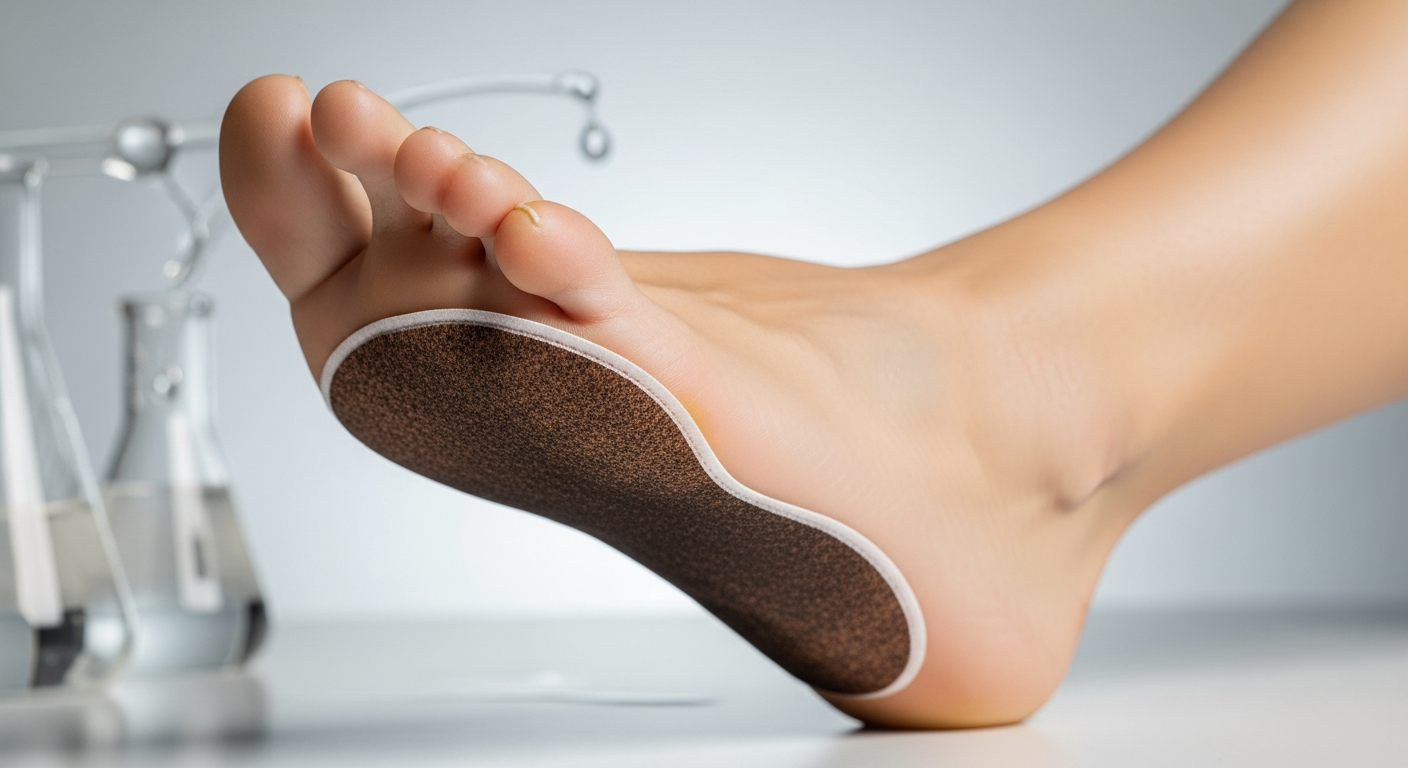
If you have already read our previous guide on the basics of detox foot pads, you know that these adhesive patches have taken the wellness world by storm. But we left one massive question hanging in the air, a question that is so central to the product’s success that it deserves its own dedicated deep dive. That question is: Why do detox foot pads turn black?
It is the single most convincing piece of visual “evidence” these companies have to offer. You go to sleep with a pristine, snow-white pad strapped to your sole. You wake up, peel it off, and are greeted by a dark, oily, foul-smelling swamp of sludge. Visually, it is undeniable. Something definitely happened during the night.
In this post, we are going to leave the marketing fluff completely behind and put on our lab coats. We are going to explore the specific chemical interactions between wood vinegar, dextrin, and human sweat. We will debunk the myths surrounding the “color charts” that come in the box, analyze the actual composition of the sludge found in laboratory tests. We are going to break this down so thoroughly that by the end, you will be able to explain the chemistry to anyone who asks.
What is Actually Inside the Sachet?
To understand the reaction, we first have to deeply understand the reagents involved. You cannot understand why a cake rises without knowing what baking powder does, and similarly, you cannot understand the Why do detox foot pads turn black without understanding the specific properties of the powder inside the patch. While different brands might sprinkle in marketing ingredients like lavender or tourmaline, the chemical engine that drives the color change consists of two main components: Pyroligneous Acid and Binding Starches.
Role of Pyroligneous Acid (Wood Vinegar)
The most critical ingredient in any detox foot pad is “Wood Vinegar” or “Bamboo Vinegar.” In scientific terms, this substance is known as Pyroligneous acid. This is not the kind of vinegar you put on a salad; it is a complex mixture produced during the carbonization of wood. When wood is heated in an airless environment to make charcoal, it releases smoke and steam. If you capture that hot smoke and run it through a cooling tube, it condenses into a liquid. In its natural liquid state, wood vinegar is a reddish-brown or dark amber fluid. It contains acetic acid, acetone, and methanol, which gives it that distinct, overpowering “barbecue” or “smoked meat” odor that you notice immediately when you open a foot pad.
However, you cannot put a liquid into a porous patch, or it would leak everywhere before you even bought it. To solve this, manufacturers dehydrate this liquid vinegar. They spray-dry it until it becomes a fine, off-white or light-grey powder. Here is the scientifically fascinating part: this powder is hygroscopic. This means it aggressively attracts and holds water molecules from the surrounding environment. The powder is essentially desperate to return to its liquid state. When it gets wet, it doesn’t just get damp; it chemically re-hydrates. As it dissolves in water, it reverts to its natural color, which is that deep, dark, reddish-brown tar-like shade. This intrinsic color of the vinegar is the primary source of the “blackness” you see in the morning.
The Function of Dextrin (The Binder)
The second most important ingredient, which works hand-in-hand with the vinegar, is Dextrin. Dextrin is a low-molecular-weight carbohydrate produced by the hydrolysis of starch or glycogen. You can think of Dextrin as the “glue” of the operation. In its dry state, it is just a simple white powder that looks like flour. However, its physical properties change drastically when water is added.
When Dextrin gets wet, it becomes an extremely sticky, gummy paste. If the foot pads only contained wood vinegar, the result in the morning would be a wet, brown stain on your foot, similar to spilling coffee. It wouldn’t look like “toxins.” The Dextrin is added to bind with the vinegar and the moisture to create a thick, slime-like texture. It gives the mixture volume and viscosity, mimicking the look of mucus or heavy biological waste. This texture is crucial for the psychological effect of the product because it makes the user feel that something “heavy” and substantial has been pulled out of the body, rather than just sweat and dissolved powder.
Now that we understand the ingredients, let’s look at the process in motion. What exactly happens during those eight hours of sleep that causes the detox foot pads to turn black? It is not a magical extraction process; it is a predictable sequence of Hydrolysis and Oxidation triggered by the unique environment of the human foot.
Step 1: The Greenhouse Effect
The process begins the moment you apply the adhesive sheet over the powder sachet onto your foot. By doing this, you are essentially creating a sealed micro-environment against your sole. Your feet are biologically designed to be the sweatiest part of your body. Even when you are completely at rest and sleeping, the eccrine sweat glands on your soles are releasing moisture to regulate temperature and maintain skin hydration. Under normal circumstances, this sweat would evaporate into the air. However, the plastic backing of the foot pad prevents this evaporation. This creates a “greenhouse effect,” trapping body heat and moisture directly against the skin.
Step 2: Solubilization and Oxidation
As the trapped sweat accumulates, it begins to penetrate the porous membrane of the sachet containing the powder. This is where the chemistry kicks in. The water molecules contact the dried wood vinegar powder, triggering solubilization. The powder dissolves and instantly begins to revert to its natural dark brown color. Simultaneously, the water activates the Dextrin, turning the mixture into that sticky paste we discussed earlier.
Furthermore, your body heat plays a massive role here. The human body is roughly 98.6°F (37°C). Chemical reactions generally occur faster and more aggressively in warm environments. The heat from your foot acts as a catalyst, encouraging the powder to dissolve thoroughly and increasing the rate of oxidation. Some chemists also suggest that a form of the Maillard Reaction—a chemical reaction between amino acids and reducing sugars that gives browned food its distinct flavor and color—might be occurring on a minor scale. The trace amino acids in your sweat, reacting with the starches in the pad and the acidic vinegar in a warm environment, could contribute to deepening the color from a brown tea shade to a pitch-black sludge over the course of the night.
Debunking the “Color Chart” Myth
If you have ever purchased a box of these pads, you might have seen a “color chart” included in the packaging or displayed on the website. These charts are fascinating pieces of marketing fiction that attempt to assign medical meaning to the random chemical chaos occurring in your sock. The charts usually claim that a green sludge indicates liver detoxification, a red sludge indicates heart issues or blood clots, and a black sludge indicates heavy metals.
This is scientifically baseless and misleading. We need to understand that the color variations are caused by environmental variables, not organ function. For example, if the sludge appears greenish, it is almost certainly because the manufacturer added a herbal powder like Green Tea, Kelp, or Cabbage to the mixture. When dried green vegetable matter gets wet, it turns into a green paste. It has nothing to do with your gallbladder.
Similarly, if the pad appears yellow or light brown instead of black, it does not mean you successfully detoxed your spleen. It simply means there was less moisture present. If your feet didn’t sweat as much that night, the wood vinegar powder didn’t fully dissolve or oxidize, resulting in a lighter, partially hydrated paste. The “blackness” is simply the end-stage of the vinegar fully saturating and oxidizing. It is a measure of how wet the pad got, not how toxic your internal organs are.
The “Toxin” Myth: Analyzing the Sludge in a Lab
Let’s play devil’s advocate for a moment. Is it remotely possible that hidden inside that black vinegar paste, there are actually heavy metals drawn from your body? To definitively answer “why do detox foot pads turn black,” we have to look at what independent laboratories have found when they tested the used pads using high-tech equipment like mass spectrometry.
Several major news outlets, including ABC News and NPR, have commissioned these exact types of lab tests. The methodology was simple and robust: they took a “clean” pad and hydrated it with steam, and then compared it to a “used” pad that had been worn on a human foot all night. The hypothesis was that if the pads worked, the “used” pad should contain drastically higher levels of arsenic, mercury, lead, and benzene.
The results were consistent and damning. The laboratories found no significant difference in the heavy metal composition between the steam-hydrated pad and the foot-worn pad. When they analyzed the chemical makeup of the sludge, they found exactly what you would expect to find in a wet bag of ingredients: wood vinegar, dextrin, water, and the standard components of human sweat. Human sweat is 99% water, but it does contain trace amounts of sodium, chloride, urea, lactic acid, and dead skin cells. That is what was in the pad. The black color was intrinsic to the vinegar itself; it was not a dye or a toxin brought into the pad from your body. The lab tests proved that the “toxins” are a marketing fabrication.
Control Experiments: Proving It Is Just Moisture
You do not need a mass spectrometer to prove this to yourself. You can perform simple control experiments at home that strip away the biological variables and prove that moisture is the only thing required to turn the detox foot pads black.
Consider the “Distilled Water Test.” Distilled water is chemically pure H2O. It has been boiled and condensed to remove all impurities, minerals, bacteria, and “toxins.” If you take a fresh detox foot pad and drop 5 milliliters of distilled water onto it, the pad will turn black. It will develop the exact same sticky, dark appearance as it does when worn on your foot. Since we know there are no heavy metals or liver toxins in distilled water, the only logical conclusion is that the color change is a reaction to the water itself.
Another way to visualize this is the “Sweaty Sock Variable.” If toxins were truly exiting your feet in such massive quantities that they could stain a pad jet-black, think about what would happen to your socks during a workout. When you go for a run, your feet sweat heavily, releasing moisture into your socks. Yet, when you take your socks off, they are damp and grey, not stained black with heavy metals. Why? Because your socks do not contain wood vinegar powder. The “black” is waiting inside the pad; it is not coming out of you.
Why Does The Blackness Stop Eventually?
One of the most common things users report is that after using the pads for a few weeks, the pads stop turning jet black and start appearing lighter or greyer. This phenomenon often convinces users that the detox “worked” and they are now “clean.” However, there is a physiological explanation for this too, and—surprise—it’s not about toxins running out. It is about acclimatization and moisture regulation.
When you first start sticking adhesive pads to your feet, it is a foreign sensation. Your body reacts to the occlusion (blockage) and the heat of the tourmaline by producing more sweat in an attempt to cool the area and flush the skin. Over time, your body may acclimatize to the presence of the pad, producing slightly less sweat in that specific area. Furthermore, wood vinegar is acidic and astringent. Using it every single night for 30 days can dry out the skin on the soles of your feet. Drier skin means less moisture is available to react with the powder. The “fading” of the color is not a sign of purity; it is simply a sign that your feet are drier than they were when you started.
Conclusion
So, to summarize our deep dive into the science: Why do detox foot pads turn black? They turn black because a dehydrated, acidic vinegar powder is reacting with the sweat from your feet and a starchy binding agent. It is a predictable, repeatable chemical reaction that can be replicated with tap water, steam, or distilled water.
There is absolutely no scientific evidence that the darkness is caused by heavy metals, parasites, or liver toxins leaving your body. The transformation from white powder to black sludge is a chemical magic trick, not a biological exorcism. While the ritual of using the pads might be relaxing, and the warmth might help you sleep, it is crucial to understand that you are not peeling off years of bad diet and pollution. You are simply peeling off a wet chemistry experiment. Your body is cleaner than you think, and that black sludge is just a little bit of sweat and a whole lot of vinegar.