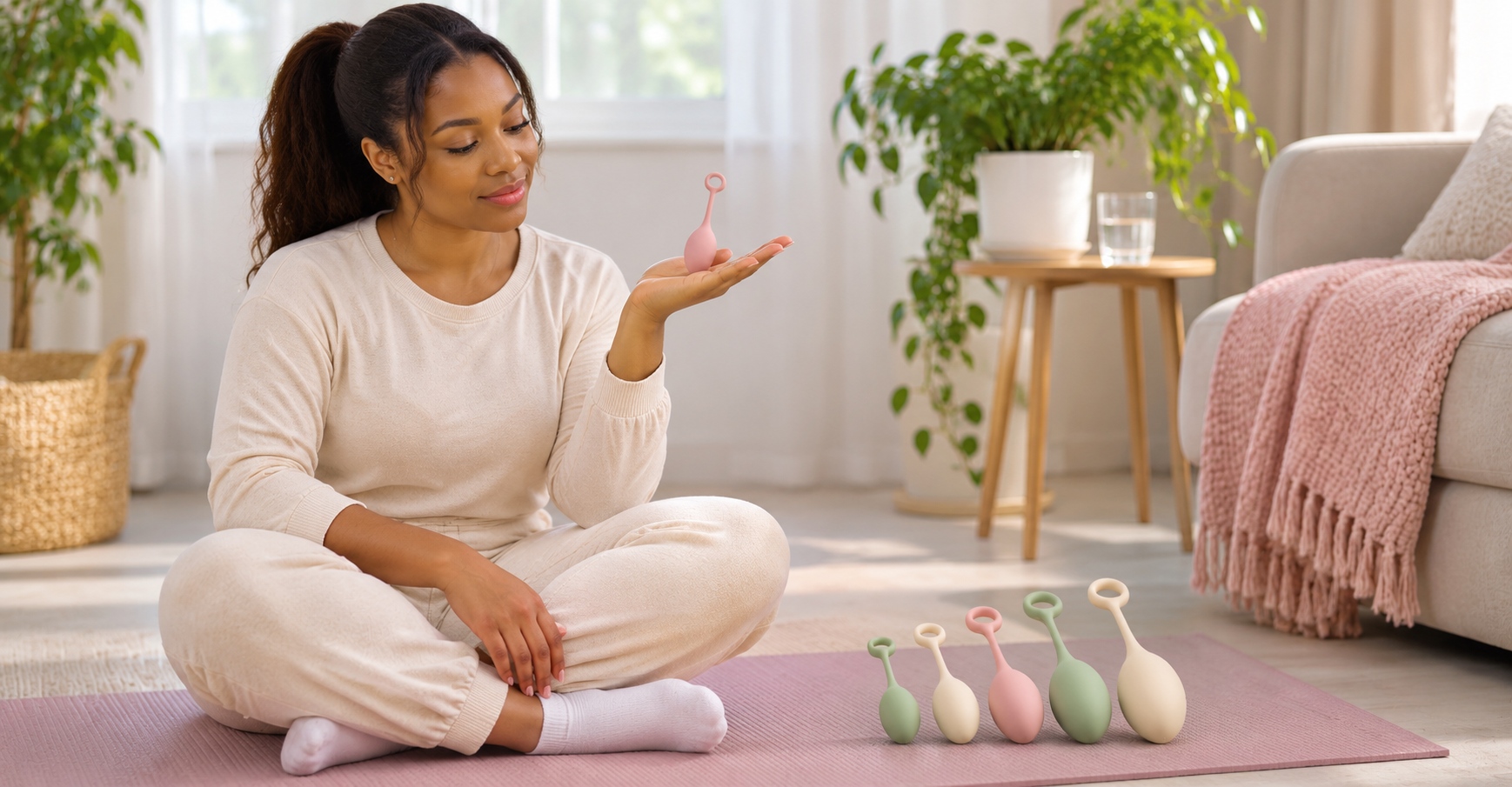
Kegel pelvic exercise weights are small weighted devices that you place in the vagina and hold in place with your pelvic floor muscles. The idea is simple. If the weight is going to stay put, the muscles have to work. Whether that gives you better results than regular Kegels, and whether it’s a good idea for you at all, depends on things like pregnancy history, prolapse, pelvic pain, and whether your pelvic floor is weak or tight.
This article explains how the weights work, what the research says, who should hold off, and how to use a set if it’s appropriate for you. It’s general information, not an exam. If you already know you have a prolapse, read pelvic exercises for a prolapsed bladder first, because that changes the advice quite a bit.
What Are Kegel Pelvic Exercise Weights?
You’ll see them sold as vaginal cones, Kegel balls, weighted teardrops, or “smart” trainers that connect to a phone app. Cones are tampon-shaped and often made of plastic-coated steel. The balls and teardrops are usually medical-grade silicone. Most sets come with about six weights, running from roughly 20 grams to 100 grams.
Jade eggs and yoni eggs get sold alongside them. There’s no good evidence that they help with pelvic floor training, and they aren’t built the way graded sets are, so they’re not a substitute.
When you insert a weight, your pelvic floor muscles automatically tighten to keep it from slipping out. As the muscles tire, the weight starts to slide. That gives you a built-in signal for whether you’re squeezing, which is the main reason people like them.
Do Kegel Weights Work Better Than Regular Kegels?
Not clearly. A Cochrane review looked at studies of vaginal weights used for stress urinary incontinence, the leaking that happens when you cough, sneeze, or exercise. When weights were compared with pelvic floor muscle training done without weights and with electrical stimulation, no clear difference between the treatments showed up.
That doesn’t mean the weights are useless. They can help in a few specific ways:
- They give feedback. Many people can’t tell whether they’re squeezing the right muscles. Some bear down instead or squeeze their glutes. A weight that slips out tells you something.
- They add a bit of load, the way a heavier dumbbell does for your arm.
- Some people stick with the routine better when they can move up through a set of weights and see progress.
They also have downsides. Some people find insertion uncomfortable, physically or emotionally, and in some studies more people dropped out of the weights group than the no-weights group. If regular Kegels work for you, there’s no research-backed reason to switch.
Who Should Skip Kegel Weights or Wait
Pelvic floor training helps a lot of people, but it isn’t right for every pelvic problem, and weights add another layer of risk. Skip them, or get cleared first, if any of these apply:
- You’re pregnant, or you’re recovering from childbirth
- You’ve had gynecological or vaginal surgery recently (one NHS leaflet says to wait at least 12 weeks after vaginal surgery)
- You have a vaginal or urinary infection
- You have pelvic pain, or pain during sex
- You’re on your period (the same NHS leaflet advises against using cones then)
- You have a severe prolapse
Prolapse deserves a closer look because people often reach for weights when they notice heaviness or a bulge. A pelvic floor physiotherapist quoted by Galaxus warned that weights can backfire for women with organ descent. Mild prolapse is a different story, and pelvic floor training does have research support there, but whether weights belong in your plan is a call for someone who has examined you.
Is Your Pelvic Floor Weak or Tight?
This is the question most people skip, and it matters more than which set you buy. A weak pelvic floor needs strengthening. A tight one needs to learn to let go. Adding weight to an already overactive pelvic floor can make symptoms worse, including pain, a constant urge to pee, and discomfort during sex.
Signs your pelvic floor might be tight rather than weak include pain with insertion, difficulty fully relaxing after a squeeze, and pelvic or lower-back aching that builds through the day. Hip trouble often travels with it. Stiff hip flexors can be part of the picture, and psoas exercises are one option a therapist might use there, though a tight psoas isn’t automatically the cause of anyone’s pelvic symptoms. Hip joint problems such as impingement have their own rules too, and hip impingement exercises are chosen based on which positions bring your symptoms on.
Some people with a tense pelvic floor also explore relaxation-based practices. Trauma release exercises, often shortened to TRE, are one example. They involve movements meant to bring on a natural shaking response. The evidence for what they treat is limited, so they’re not a replacement for a pelvic floor assessment, particularly if pelvic pain is tied to a past traumatic experience and you’d benefit from proper support.
How to Choose a Set
Look for a graded set so you can start light and move up. Smooth, medical-grade silicone is easier to clean and gentler than rough plastic. A retrieval cord or loop makes removal easier and takes away the worry of a weight getting stuck. Extra cost doesn’t buy better results. The NHS leaflet on vaginal cones makes the same point.
Pick the lightest weight that stays in when you’re lying down and squeezing. Starting too heavy is the most common beginner mistake, and it leads to bearing down, gripping with your glutes, and more strain than benefit.
If hand pain makes it hard to handle a small, slippery device, sort that out first rather than forcing it. A locking thumb, for instance, has its own exercise approach, and trigger thumb exercises are a different topic from anything pelvic.
How to Use Kegel Pelvic Exercise Weights
Before the first session
Wash your hands and the weight, and use a water-based lubricant if you need one. Start lying down. Gravity pulls less on the weight in that position, so it’s the easiest place to learn what the squeeze feels like.
If getting down to the floor hurts your shoulder, use a bed instead. Shoulder problems like a labral tear call for their own rehab, and PT exercises for torn labrum look nothing like pelvic floor work. If your shoulder is stiff in every direction rather than catching, the issue may be something else, and exercises for capsulitis cover that separately.
Starting out
Insert the weight like a tampon, then tighten your pelvic floor as if you were lifting it upward. Hold for a few seconds, release fully, and repeat. The release counts as much as the squeeze. Breathing out as you squeeze usually feels more natural than holding your breath, and it keeps you from bearing down.
Session length varies between programs. Many run somewhere between 10 and 20 minutes, once or twice a day, but follow whatever a pelvic floor therapist gives you over a number from an article. Your muscles tire as the day goes on, so you may manage a heavier weight in the morning than in the evening, and some people notice they feel weaker before their period.
Moving up
Once you can hold the weight in while moving around without it slipping, you can try standing or walking slowly around the house. This is where other aches start to matter. If your lower back is irritated, check L5-S1 exercises to avoid before adding standing work, since bending and heavy straining can aggravate that area. Foot and lower-leg problems change the walking part too. PT exercises for drop foot and stretch exercises for shin splints are two very different approaches, and neither condition should be pushed through just to complete a weights session.
Don’t wear the weights during sport or lifting. The pelvic floor already works hard in those, and adding a weight on top of that is asking for trouble.
Posture and breathing are part of the same system. The diaphragm and pelvic floor move together, so a rounded, head-forward posture can make relaxed breathing harder. If you’re working on that with neck hump exercises and the chin tuck exercise, treat it as a separate project that may make pelvic floor work feel easier, not as a replacement for it.
Cleaning and storage
Wash every part of the weight with soapy water after each use, rinse it, and dry it thoroughly. Keep it in a clean container. Don’t share it.
Mistakes and Warning Signs
A few habits cause most of the trouble:
- Starting with a weight that’s too heavy
- Bearing down instead of lifting
- Never fully relaxing between squeezes
- Using weights every day through pain
- Skipping an assessment and guessing at the cause
Stop and get checked if you notice pain, burning, spotting or bleeding, unusual discharge, new urinary symptoms, or a growing sense of heaviness or bulging. Tingling or burning that doesn’t settle is a nerve-type symptom, and nerve symptoms need different handling from muscle soreness. That’s true anywhere in the body. In the arm, for example, ulnar nerve entrapment exercises aim at reducing pressure on a specific nerve, which is a different goal from strengthening.
Frequently Asked Questions
Do Kegel pelvic exercise weights actually work?
They can help some people, mainly by giving feedback and adding a little load. Studies comparing them with pelvic floor training done without weights haven’t found a clear advantage for either.
Are Kegel weights better than regular Kegels?
Not necessarily. Regular Kegels done correctly work as well in the research, and they cost nothing. Weights help people who struggle to feel the right muscles or want something to progress through.
How long should you hold Kegel weights in?
It depends on the program. Many sessions run roughly 10 to 20 minutes once or twice a day. A pelvic floor therapist can set a schedule that suits your muscles and symptoms.
Can you use Kegel weights with a prolapse?
Not without checking first. A severe prolapse is a reason to avoid cones, and even with mild prolapse, the weights aren’t a safe default. Get examined first.
Can you use Kegel weights while pregnant or after birth?
Pregnancy is a reason to avoid them, and so is the recovery period after childbirth. Ask your doctor or a pelvic floor physiotherapist when it’s reasonable to start.
What weight should a beginner start with?
The lightest one in the set. It should stay in while you’re lying down and squeezing. If you have to grip hard or bear down to keep it in, it’s too heavy.
Can Kegel weights make symptoms worse?
Yes, particularly if your pelvic floor is tight rather than weak, or if you use them through pain. A tight pelvic floor needs to learn to relax, and extra load can work against that.
When should you see a pelvic floor physiotherapist?
Ideally, before you buy a set, and definitely if you have pain, leaking, heaviness, or a bulge, or if you can’t tell whether you’re squeezing the right muscles.
Conclusion
Kegel pelvic exercise weights are one tool among several, and the research doesn’t show them beating plain pelvic floor training. They make the most sense for someone with a healthy, reasonably relaxed pelvic floor who has trouble feeling the right muscles, and they make the least sense for someone with pain, a severe prolapse, an infection, or a recent birth or surgery.
If you’re not sure which camp you’re in, a single visit with a pelvic floor physiotherapist is cheaper than a set of weights you end up not using. For the bigger picture on how exercise choices change from one injury to the next, see Exercises for Common Injuries and Joint Pain.