Psoas exercises are stretches and strengthening moves aimed at the deep hip muscle that links your lower spine to your thigh. They can help when your hips feel tight after long hours of sitting, or when a hip flexor feels weak or strained. They won’t fix every back or hip problem, and that’s the part most guides skip.
This article explains where the psoas sits, what it does, which psoas exercises are worth trying, how to do the most common one properly, and when to stop and get checked. Some of the sources I used disagree with each other, and I’ll point out where.
Everything here is general information. It isn’t a diagnosis or a personal treatment plan.
What Is the Psoas, and What Does It Do?
The psoas is a deep muscle that runs from your lower spine to your thigh bone. Its main job is lifting your thigh toward your body, which you do every time you walk or climb stairs.
Where the Psoas Sits
The psoas major starts on the sides of the lower spine, including the vertebrae of the lower back, passes through the pelvis, and attaches to a small bump on the upper thigh bone called the lesser trochanter. Kenhub, an anatomy reference, notes that it joins with a second muscle, the iliacus, and the pair is called the iliopsoas.
What the Psoas Does
Besides bending the hip, the psoas helps hold your spine upright. Kenhub describes it as a postural muscle that stabilizes the lower spine when you stand. Because it connects your back to your leg, a problem in this area can show up as pain in the lower back, the front of the hip, or the groin. A 2025 review in JBJS Reviews describes iliopsoas injuries as a common cause of front hip and groin pain.
Can Psoas Exercises Relieve Back or Hip Pain?
They can help some people, mostly when the pain comes from a tight, weak, or strained hip flexor. They aren’t a cure for back or hip pain in general, and experts disagree about how much a tight psoas explains.
Some clinicians say a tight psoas can pull on the pelvis and contribute to pain in the back, hips, and groin. Others call that idea overstated. A session from the IDEA Health and Fitness Association calls the popular story of a tight psoas, short hip flexors, and weak glutes behind the hip and back pain largely an industry myth. One hospital group’s patient guide takes a middle position: tightness is only one possible explanation, and weakness, overuse, or irritation of nearby structures can feel similar.
So treat psoas exercises as a reasonable thing to try, not as proof of what’s wrong. If they help, good. If they make things worse, that tells you something too.
Why Hips Get Tight and Achy
Long periods of sitting are the most common reason. Harvard Health says sitting for long stretches causes the hip flexors to tighten and shorten, which can lead to stiffness and discomfort.
Overuse is another. Intermountain Health lists repetitive stress such as too much running or cycling as a cause of hip flexor tendinopathy, along with sudden injuries like a fall. Healthline adds that deep stretching, such as pulling the thigh backward hard, raises the chance of straining a hip flexor.
Tight doesn’t always mean short, though. One physical therapist quoted by Well+Good argues that achy hip flexors are sometimes weak ones, with one hip flexor muscle overworking because another isn’t pulling its share. That’s why a routine that only stretches can leave you no better off.
Fitting Psoas Exercises Into a Sitting Day
You don’t need a separate workout. The easiest time for psoas exercises is right after a long stretch in a chair, when the hip flexors are shortest.
Breaking up long sitting spells with a short walk helps too, because sitting less is the plainest way to keep hip flexors from tightening. A few minutes of the kneeling stretch after work, or before a run, costs little.
Keep expectations modest. One session won’t undo years of sitting, so don’t expect a quick fix. Regular, gentle practice over weeks is the realistic goal, and it’s fine to skip a day when the hip feels irritated.
Desk Hours and the Other Aches They Bring
If you sit all day, your hips are rarely the only thing complaining.
The same hours often round your upper back and push your head forward. That’s a different fix, and neck hump exercises and the chin tuck exercise are the usual starting points. Don’t assume a bump at the base of the neck is posture, though. Cleveland Clinic lists osteoporosis-related spinal fractures as another cause.
Elbows bent for hours can irritate a nerve. The American Academy of Orthopaedic Surgeons describes numbness and tingling in the ring and little fingers as the typical signs of ulnar nerve entrapment and says symptoms are often worse with the elbow bent. Ulnar nerve entrapment exercises belong to that problem, not to the hips.
A thumb that catches or locks is a hand problem. Mayo Clinic describes trigger finger and thumb as getting stuck in a bent position, and the NHS says it can improve on its own. Trigger thumb exercises cover that separately.
Shoulders deserve a mention too. Frozen shoulder and labral tears can look alike early on, so a clinician has to sort them out. Exercises for capsulitis and PT exercises for torn labrum take very different paths.
Psoas Exercises That Stretch
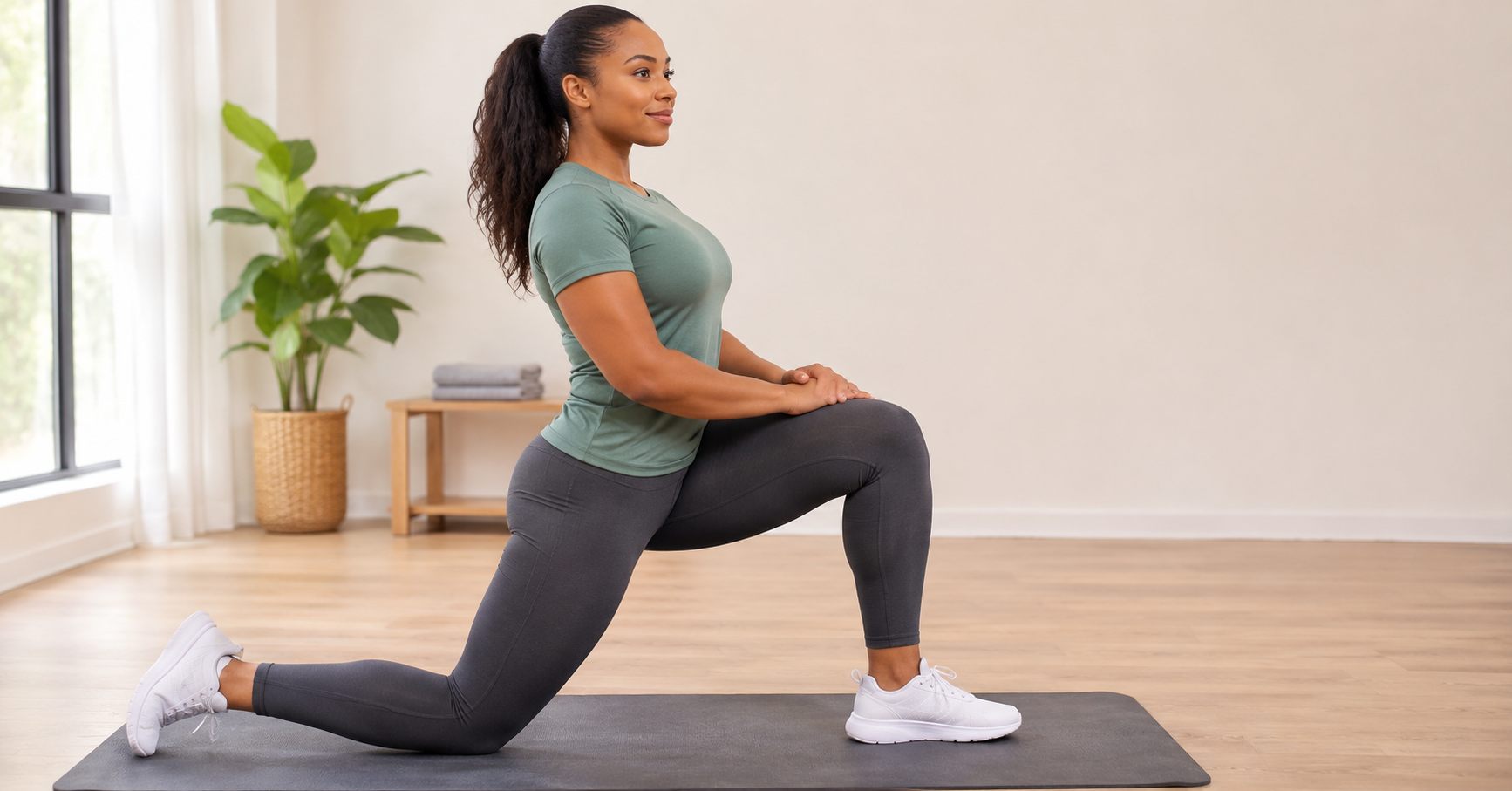
A kneeling hip flexor stretch is the standard stretch. Harvard Health says holds of 10 to 30 seconds are enough, so don’t force anything.
The Kneeling Hip Flexor Stretch
Kneel on one knee on a padded surface, with the other foot flat in front of you and that knee roughly above the ankle. Tuck your pelvis under, as if bringing your tailbone toward your front. Keep your torso upright. Then shift your weight forward gently until you feel a pull at the front of the hip on the kneeling side. Hold for about 30 seconds, then switch sides.
Several physical therapy clinics stress the pelvic tuck because, without it you just arch your lower back and feel nothing in the hip.
Common Mistakes With Psoas Exercises That Stretch
Arching the lower back, leaning forward from the waist, and bouncing are the usual problems. If you feel the stretch in your back, you’ve lost the tuck, so reset and go smaller. A stretch should feel like a pull. Anything sharp, pinching, or travelling down the leg is a reason to stop.
Other Stretch Options
Harvard Health describes several versions of hip flexor stretches, and the principle is the same in each: a gentle pull, short holds, and both sides. If kneeling bothers your knees, a physical therapist can suggest a version that doesn’t.
Psoas Exercises That Strengthen
Strengthening works best when the hip is bent, with the leg lifting toward your chest. A 2024 systematic review in the Journal of Clinical Medicine looked at studies measuring muscle activity and found the iliopsoas works hardest in hip positions of about 30 to 60 degrees of bend, especially with leg raising and lowering. The authors suggest progressing from easier exercises to harder ones and adding outside load last.
Lying Straight Leg Raise
Lie on your back with one knee bent and that foot flat. Keep the other leg straight, tighten the thigh to lock the knee, then breathe out and lift the leg until it’s level with the other thigh. Lower it slowly. Don’t let your back arch or your pelvis twist. One physical therapist quoted by Well+Good turns the toes out about 45 degrees to emphasize the iliopsoas.
Seated Knee Lifts
For a gentler start, sit tall and lift one knee a few inches without leaning back, then lower it with control. Well+Good’s physical therapist lists a seated version as one of three starter exercises, alongside lying leg raises.
Doing Psoas Exercises for Strength Safely
Add reps before you add weight. If an exercise leaves you sore the next day or makes the hip pinch, scale it back.
How Often to Do Psoas Exercises and What to Feel
There’s no single schedule that fits everyone. Physical therapy clinics commonly use two or three holds of about 30 seconds per side for the kneeling stretch, but your pain, history, and goals change that.
A gentle warm-up helps. Healthline suggests a short walk of about three minutes before stretching. A mild pull or muscle tiredness is normal. Sharp pain, pinching in the front of the hip, or pain that’s worse the next day means you’ve done too much.
If you’ve had hip surgery, follow your surgeon’s plan instead of this article. Rehab guidelines from the Hospital for Special Surgery for hip arthroscopy, for example, warn against aggressive stretching.
While You Recover: Psoas Exercises and Rest
If your hip flexor is strained, rest comes first. Cleveland Clinic says most strains can be treated at home with rest, icing, and over-the-counter medicine, and that sitting out a sport for a few weeks is common and frustrating.
MedlinePlus advises stopping any activity that causes pain. The University of Florida’s care sheet suggests doing exercises that don’t strain the hip flexors in the meantime, such as swimming, and says to call your provider if you aren’t better in a few weeks.
Gentle psoas exercises can come back in as pain settles. Start with the easy stretch before the leg raises. Healthline warns that skipping rest after a strain usually leads to a worse injury and more pain later.
Hip Pain That Isn’t a Tight Psoas
A pulled hip flexor feels different from tightness. Cleveland Clinic lists pain, a pulling feeling in the hip, limping, and weakness in the lower abdomen or hip as symptoms. MedlinePlus adds that gentle stretching to extend the hip can help recovery and that a severe strain may need a physical therapist.
Snapping or clicking at the front of the hip is another pattern. Internal snapping hip comes from the iliopsoas tendon moving over bone. A published review of snapping hips says most cases resolve with conservative treatment, including avoiding aggravating activities, stretching, and anti-inflammatory medicine, and that surgery is for cases that don’t respond.
Pinching in the front of the hip or groin, especially when you bring your knee up, can come from hip impingement. Hip impingement exercises are individualized. A hip protocol published in the British Journal of Sports Medicine describes a physiotherapist-led program built around assessment and an exercise plan matched to the person. A deep psoas stretch is not a safe guess for that problem.
What a Physical Therapist Checks Before Psoas Exercises
A physical therapist can tell you whether psoas exercises make sense for you. A hip flexor test called the Thomas test is one tool, and a clinician quoted by National Geographic uses it to find out which part of the hip flexor is tight. The same article notes that if changing position doesn’t change the pain, the cause may be something other than a muscle.
The British Journal of Sports Medicine hip protocol mentioned above gives a fair picture of a good visit: a detailed assessment, advice, help with pain, and an exercise plan matched to you. Scans usually aren’t needed for hip flexor tendinopathy, according to Intermountain Health, so don’t expect an MRI by default.
Back Problems and the Psoas
The psoas attaches along the lower spine, so back and hip flexor trouble often get tangled together. That doesn’t mean the same routine suits both.
If you’ve been told you have a disc problem at the lowest level of the lumbar spine, read L5-S1 exercises to avoid and check with your clinician before adding deep stretches or leg raises. The right choices depend on your diagnosis and on how your symptoms behave, especially pain travelling down the leg, numbness, or weakness.
Pelvic Floor Tension and the Hips
The hips and pelvic floor sit side by side, and trouble in one can feel like trouble in the other. PainWeek, a pain medicine organization, notes that hip problems are often overlooked in people with pelvic pain, and that many people with chronic pelvic pain have tender pelvic floor muscles that don’t relax well.
If you have heaviness, a bulge, or leaking, those symptoms need their own assessment. Pelvic exercises for prolapsed bladder start from that assessment, not from hip stretches. The same goes for Kegel pelvic exercise weights. Prevention Australia warns that unsupervised strengthening can aggravate an overactive pelvic floor.
Some people with deep hip or pelvic tension look into Trauma release exercises, often shortened to TRE. The research is thin, mostly pilot studies and small trials, so it shouldn’t replace an assessment.
Leg and Foot Symptoms That Aren’t Hip Flexor Trouble
A strained hip flexor doesn’t make your foot drop. Drop foot means you can’t lift the front of the foot, and it most often comes from a problem with the peroneal nerve. A podiatry clinic notes it can also come from a nerve root in the lower spine. PT exercises for drop foot depend on the cause, so new foot weakness needs a proper check.
Runners who feel front hip pain after a sudden jump in mileage may also feel it along the shin. Shin splints cause pain along the inner shinbone from repeated stress, often after training increases too fast. Stretching exercises for shin splints belong to that problem, and they won’t help a hip flexor strain.
When to See a Doctor
Get checked if you’re limping, if home care hasn’t helped after about a week (Healthline’s guideline), or if you have ongoing pain in your hip or groin, which Intermountain Health says needs an exam. Also seek care for pain after a fall or collision, inability to put weight on the leg, sudden swelling, or fever.
Numbness, tingling, or weakness in the leg is a reason to stop exercising and get assessed. So is anything that keeps getting worse despite rest.
Common Questions About Psoas Exercises
What are the best psoas exercises?
The kneeling hip flexor stretch and the lying straight leg raise are the most common starting points. Which ones suit you depends on whether your hip flexor is tight, weak, or strained.
Do psoas exercises help lower back pain?
Sometimes. Clinicians disagree about how much a tight psoas contributes to back pain, so results vary from person to person.
Should you stretch or strengthen a tight psoas?
It depends. Sitting can leave hip flexors tight, but some achy hip flexors are weak instead. A physical therapist can tell which you have.
More Questions About Psoas Exercises
How long should you hold a psoas stretch?
Harvard Health says 10 to 30 seconds per hold is enough. Many therapists use about 30 seconds.
Can psoas exercises make hip pain worse?
Yes. Deep stretching can strain a hip flexor, and stretching won’t help if the cause is impingement or a snapping tendon.
When should you stop psoas exercises?
Stop if you feel sharp pain, pinching, or numbness, or if symptoms are worse the next day.
Conclusion
Psoas exercises are a reasonable first step for tight or achy hips, especially after long days of sitting. The kneeling stretch and the straight leg raise are simple, and they work best when you keep them gentle and notice how your body responds.
They aren’t an answer to every back, hip, or pelvic problem. If pain is sharp, spreading, or getting worse, a physical therapist can find out what’s actually going on.
For the bigger picture on how exercise choices change from one injury to the next, see Exercises for Common Injuries and Joint Pain.